

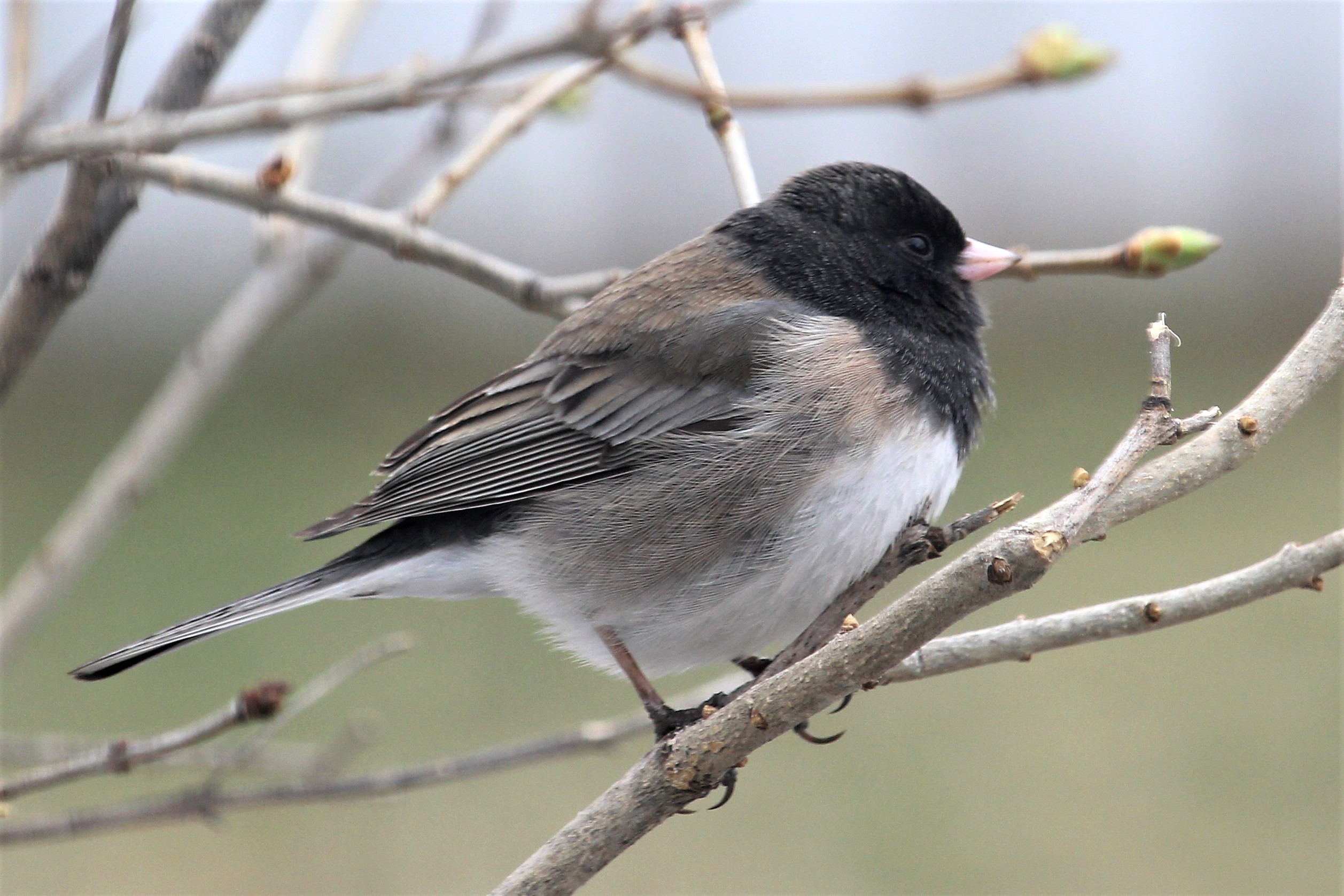
With recent heavy snowfalls in the Chestermere area, doubts about the arrival of spring are hard to resist. April “showers” bring May flowers, and they also bring a favorite member of the sparrow family; the dark-eyed junco to town. To our surprise this medium-sized sparrow made an appearance on our deck. With a number of sunflower seeds scattered about, this first ever “deck-junco”, foraged about, capturing our rapt attention. Later in the day, four juncos put on quite a show, hopping about the deck, each a slightly different shade of grey intermixed with brown feathers.
Nicknamed “snowbirds” as their arrival in the United States often coincides with the arrival of snow there, this sparrow has a variety of color variations, depending where this widespread bird lives. There are six distinguishable color variations, with two being the most common. One such variation in the eastern United States and most of Canada is slate-colored above with a white chest and underparts. The “Oregon” junco found across much of the western United States, sports a dark hood, a warm brown back and rufous flanks. Other unique variations include a “pink-sided” junco or a “white-winged” junco which live in the Rocky Mountains and Great Western Plains. Common to all variations are the bright white tail feathers that flash when they are in the quick, low level flights from one potential feeding area to another.
Although the juncos weren’t calling one another on the deck, the range of “junco music” at Elliston Park was amazing. One sound is similar to a person making a clicking sound by pushing the tongue against the roof of the mouth. Most enjoyable are the extended trill calls, we believe are used on attracting a mate. Aside from these two sounds, we do here short buzzes and clicks, reminding us of R2D2 in Star Wars movies.
Although we see the dark-eyed junco, in its smooth grey hue, we have had the good fortune of seeing Oregon juncos at Elliston Park. During the last week of March and the first week of April, these energetic birds can be seen hopping on the ground, flipping over leaves, searching for food. Timing seems to be everything in catching these sparrows in the park. Within a few days the juncos have moved on to their nesting locations across northern Canada.
The “deck-juncos” moved on after spending parts of three days at our house. As what we hope is as the last of the snow melts, we too, jump for joy when the juncos arrive. For us, they are a sign that spring is but days away.





Add Comment