


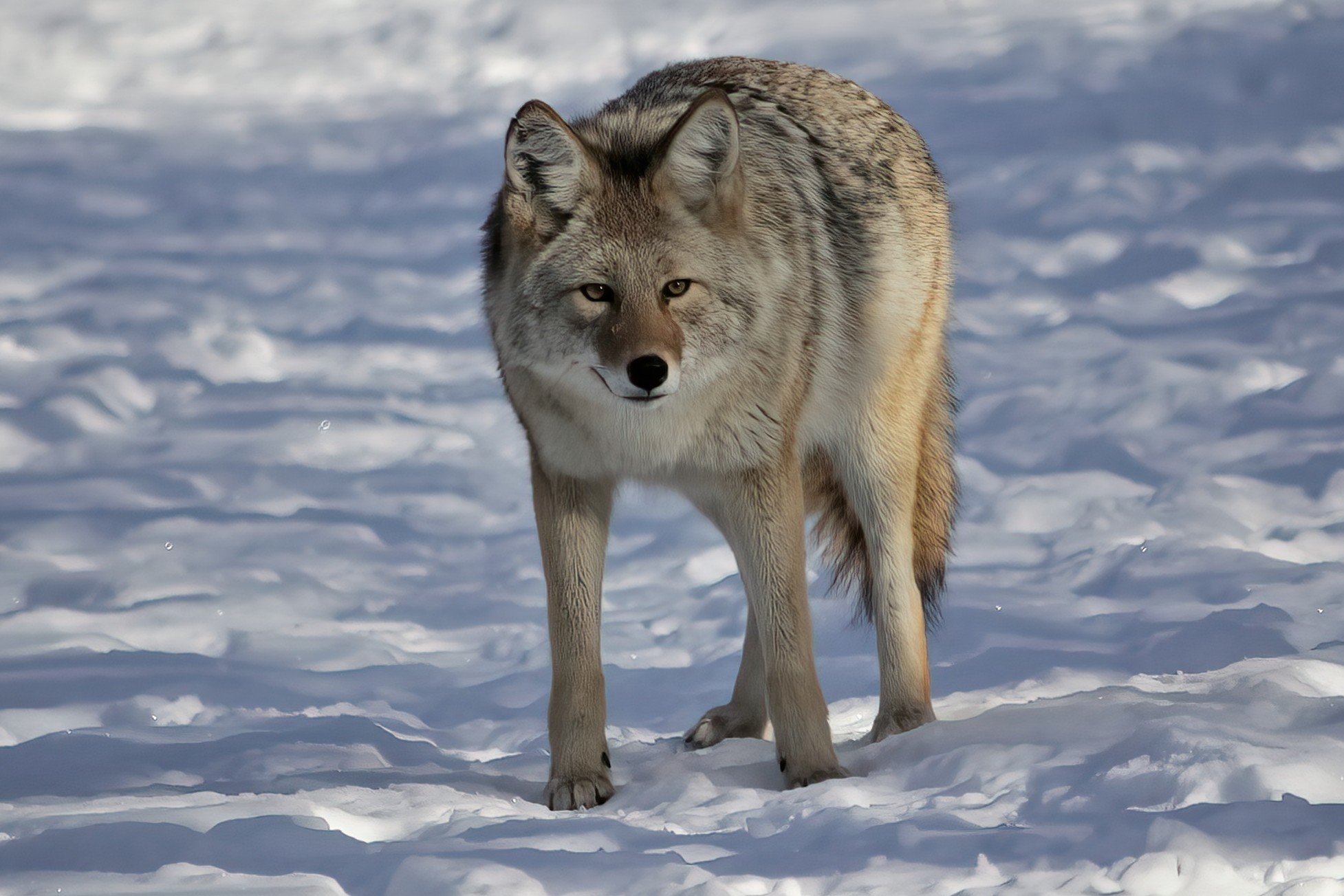
Over a half century ago after fishing for walleye at the confluence of the Beaver River and Marie Creek near Cold Lake, I was ready to enjoy the six kilometre walk home. The soft earth dampened the sound of my footsteps. Approaching a bend in the creek, a pair of eyes met mine. Less than three metres away, stood a coyote. A magnificent animal, this Canis latrans, had no immediate escape route. With the creek behind it, thickets to its left and right and me, standing in front of the coyote, it seemed as if time stopped. Looking at this coyote from head to tail, its beauty, its majesty and its serenity filled my eyes with wonder. Knowing that the coyote wished to leave, I stepped back a metre and with a quick movement, the magic of this day, left me standing alone.
I’ve admired coyotes ever since. The coyotes’ yelps and cries at night, coming from the frozen Beaver River, while I was winter camping in the late 1960s, cracked through the cold air. They were chasing snowshoe rabbits onto the river and closing in on the kill. Ready to run at the sight of a stopping vehicle, the coyote is an intelligent mammal, high tailing it even at the slightest hint of danger.
Last month, on a cloudy afternoon, Elaine and I were hoping to see the usual family of birds at Elliston Park. While having an amiable chat with a dog owner, two coyotes came into view, heading to the north side of the storm pond, where a few mallards, goldeneyes and geese were sharing a small patch of open water. Aware of us, the coyotes continued to their intended destination. It became clear that this pair of coyotes were in a most unhealthy state.
Both coyotes were suffering from sarcoptic mange, a contagious disease caused by mites. These minute mites burrow into the skin, lay their eggs, and when hatched, lead to itchiness, hair loss, and thickened skin. Severe hair loss was present on the tails and bodies of our urban coyotes.. Emaciated, and lethargic, the coyotes made little effort to nab a duck or goose along the watery edges and were unsuccessful.
Interestingly, the same mites can infect humans, but the infection is self-limiting, as the mites cannot reproduce on a person. Thank goodness! Mange does lead to the deaths of many a coyote, especially during the winter months. Starvation, exhaustion and hypothermia reduce coyote populations, in some cases by as much as 55% in localized populations. In a British Columbia study, one in four coyotes had skin diseases consistent with mange. Our coyotes sauntered out of the park and across 68th Street, heading east, continuing their search for an easy meal.
The magic and the mange, in the past and present, in health and disease, all connected through the generations of coyotes that share the land. Nature shares so many stories when we take time to look at what she reveals.
The Magic and the Mange
In response to Canada's Online News Act and Meta (Facebook and Instagram) removing access to Canada's local news from their platforms, Anchor Media Inc encourages you to get your news directly from your trusted source by bookmarking this site and downloading the Rogue Radio App. Send your news tips, story ideas, pictures, and videos to info@anchormedia.ca.
You may also like

About the author
Elaine and Don Cassidy



 BLANKET CLASSIFIEDS – Alberta-Wide Weekly Classified Ads
- Vacation Villa in BCVACATION IN CANADA'S WARMEST DESTINATION. Extraordinary villa in Osoyoos, BC, breathtaking lake views, just 3 minutes from town. Or warmer weather, two luxurious 5-star resort units in Phoenix, Arizona. Doug 306-716-2671 or visit osoyooslakevilla.com Ad Category: Recreation and Travel
- Journalism Grant Essay CompetitionAre vou looking to pursue a career in print journalism?CA MacLean Local Journalism Grant Essay Competition2 {two) – $2,000 grants availableOpen to Alberta students heading into their minimum second year post-secondary program relating to journalism Essay must convey the important role of quality community journalism plays in our modern worldAlberta Weekly Newspapers Association – CA […]
- Cash for gold & silverI PAY CA$H!! FOR ALL GOLD & SILVER COINS, JEWELRY, BARS, INGOTS, NUGGETS, GOLD Dust, Dental Gold, Bullion, Sterling Silverware, plus anything made of gold or silver!Covering ALL OF ALBERTA, and I can come to you! I also purchase coin collectionsCall Todd 780-504-7995 Ad Category: Wanted
Add Comment