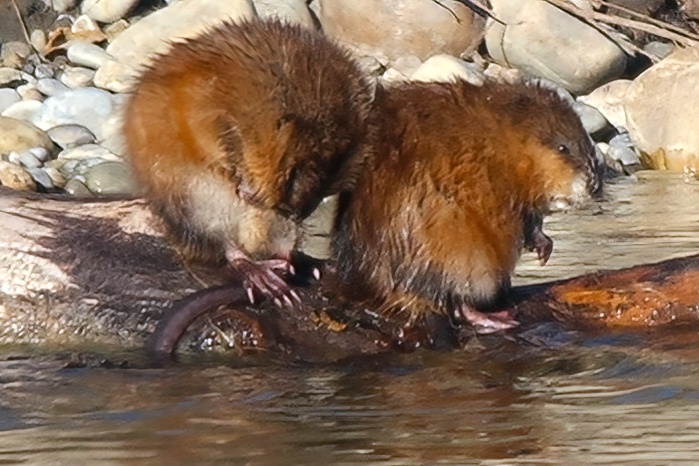
Two water-loving mammals we see while birding are the beaver and the muskrat, the muskrat much more commonly seen during daytime hours. At times we see people who are enjoying a nature stroll in one of many of Calgary’s parks, who ask what that furry, long-tailed creature is, enjoying the “salad” greens in the quiet backwaters of park ponds and banks of the Bow River.
With the unusually warm weather and lack of ice on both rivers and creeks, muskrats have been very active and visible of late. A wetland rodent, the muskrat appears to be rotund and paunchy when standing on its hind feet. With the exception of the tail and feet, the entire body is covered with a rich, waterproof layer of fur. This fur varies in color depending on its location, with dark brown covering the head, ranging to a light grayish-brown on its belly. The slender, vertically flattened tail, about 25 centimetres in length, is covered with a protective scaly skin. Very little hair grows on the front feet, which are more hand-like in appearance and function. These “hands” are used to dig extensive bank burrows and channels as well as to hold food. The muskrat’s larger unwebbed hind feet, each sporting four toes, are fringed with specialized hairs to give each foot a paddle-like effect to improve swimming. The muskrat’s two centimetre long teeth have evolved in such a way that they protrude ahead of the cheeks and lips that can close behind them. This allows the muskrat to chew on stems and roots that are underwater, without swallowing water. Muskrats also have the ability to stay under water for up to twenty minutes allowing time for them to consume vegetation up to one-third of their body weight each day.
Compared to beavers, muskrats are true light-weights, weighing between one and two kilograms, while beavers can weigh up to 32 kilograms or 70 pounds. Another distinguishing feature is that beavers have the large paddle-shaped flat tails that are used to alert other beavers of possible danger. Muskrats can be seen during daylight hours and twilight. Beavers put in their shift work at night, coming out to gnaw and cut down trees used for food, building dams and a lodge. By being active in the evening, beavers can avoid predators. Muskrats prefer roots, grasses and if needed, eat small fish and mollusks, a very different diet from a beaver’s meal.
For us, muskrats are a wonderful addition to any birding trip. Muskrats help birds by creating “hemi-marshes, a mix of water and vegetation, ideal for bird species, especially shorebirds. Muskrat lodges provide essential resting and nesting sites for swans and geese as well as other wildlife species. Muskrats have a unique positive role in creating a world in which other wildlife share. When “caught” engaged in muskrat behavior, we do experience what can only be, “muskrat love”. Add a little mammalian action to your outdoor experiences.