
A new round of water restrictions tied to critical repairs on Calgary’s Bearspaw South Feeder Main is expected to have ripple effects well beyond the city limits, with neighbouring communities including Chestermere, Strathmore and Airdrie being asked to prepare for reduced water use beginning in early March.
Calgary officials say reinforcement work on vulnerable sections of the feeder main is scheduled to begin March 9 and will last approximately four weeks. During that time, the line will be taken out of service and residents across the region will be required to limit consumption, including a ban on outdoor water use.
Mayor Jeromy Farkas has described the project as a region-wide effort, urging municipalities and residents to begin conservation efforts ahead of the shutdown.
“This is a moment for the entire region to prepare,” he said when announcing the timeline.
Why the feeder main matters
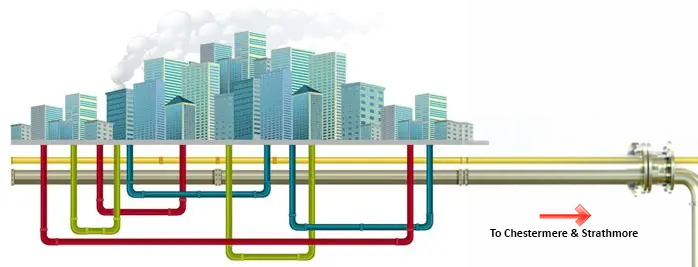
The Bearspaw South Feeder Main is a key piece of infrastructure that carries treated drinking water from the Bearspaw Water Treatment Plant into Calgary’s distribution system. Because Calgary supplies water to several surrounding municipalities through regional agreements, any disruption to that system affects communities far beyond the city itself.
Chestermere, Strathmore and Airdrie are among those that rely on Calgary’s treated water, making conservation measures necessary to ensure adequate supply while the line is offline.
Repairs driven by new deterioration concerns
The upcoming work follows the detection of additional “wire snaps” in sections of the pipe along 16 Avenue N.W. near Sarcee Trail — an area city engineers have identified as particularly vulnerable. The feeder main is made of pre-stressed concrete cylinder pipe, which uses tensioned steel wire for strength. When those wires break, the risk of rupture increases.
A catastrophic break in June 2024 flooded parts of northwest Calgary, damaged major transportation routes and triggered months of water restrictions across the region.
City officials say the reinforcement program is intended to stabilize the most at-risk segments so the existing line can remain in service until a new steel replacement pipe is completed.
The repair process involves excavating the pipe, installing an external steel reinforcing cage, encasing it in concrete and then backfilling the trench.
However, engineers have cautioned there is no absolute guarantee the work will prevent another rupture elsewhere along the line. Calgary remains at risk until the new feeder main — currently under construction — is fully operational, a project expected to be completed later this year.
What restrictions will mean locally
While the construction activity is confined to Calgary, the conservation measures will be felt across the region.
Residents in Chestermere, Strathmore and Airdrie can expect:
Limits on non-essential water use
A continued focus on indoor conservation
Public messaging encouraging shorter showers, full laundry and dishwasher loads, and reduced flushing where possible
Municipal leaders in surrounding communities are expected to mirror Calgary’s conservation messaging to ensure system-wide stability.
The restrictions also come as many fast-growing communities prepare for spring construction and landscaping season — a period that normally sees water demand rise.
A reminder about aging infrastructure
Infrastructure experts say the situation highlights the challenges cities across Canada face as major water systems built decades ago reach the end of their service life.
For rapidly growing communities east of Calgary, the issue underscores how closely local services are tied to regional infrastructure.
Population growth in Chestermere and surrounding municipalities has increased overall water demand, making the reliability of Calgary’s feeder mains more critical than ever.
Another shutdown expected
City of Calgaey officials have also confirmed a second feeder main shutdown will be required later in the year when the new line is connected to the Bearspaw Water Treatment Plant.
In the meantime, regular updates will be provided through Calgary’s project website, and regional partners are expected to share conservation guidance with their residents.
For communities across the Calgary region, the message is clear: while the repairs are taking place within city limits, the responsibility for maintaining water supply during the shutdown will be shared by everyone who depends on it.