



A proposed artificial intelligence data centre development in Chestermere could bring billions of dollars in investment to the community, but one key issue will determine whether projects like it move forward: electricity.
Across Alberta, technology companies are racing to build large data centres that power cloud computing and artificial intelligence systems. These facilities require enormous amounts of electricity to run thousands of servers that process digital information around the clock.
For communities such as Chestermere, that demand is creating both opportunity and new infrastructure challenges.
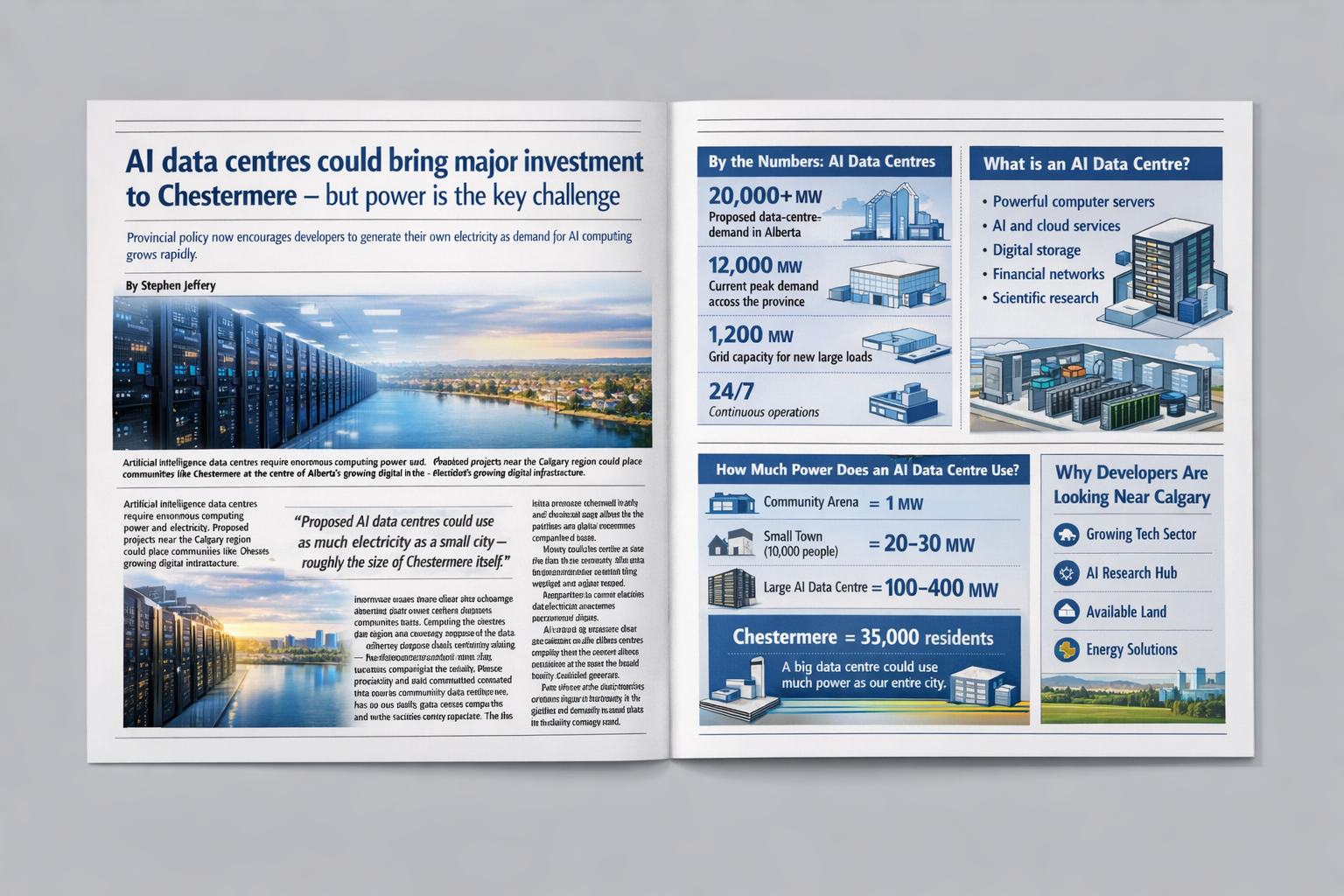
Provincial energy regulators say the existing electricity grid cannot support all the data centre projects currently proposed in Alberta. According to the Alberta Electric System Operator (AESO), more than 20,000 megawatts of new data-centre power demand has been proposed, while Alberta’s peak electricity demand is about 12,000 megawatts.
Because of that gap, the AESO has introduced limits on how much new large electricity demand can connect to the grid in the near term. The system operator says only about 1,200 megawatts of additional large-load capacity can be added without major upgrades to the transmission system.
As a result, Alberta’s strategy now encourages data centre developers to bring their own power generation or contract new electricity supply rather than relying entirely on the provincial grid.
Provincial legislation introduced in 2025 specifically supports this approach, allowing large projects to develop their own energy generation while protecting the reliability of the grid for homes and existing businesses.
For Chestermere residents, this policy shift could shape how technology developments take place locally.
Large AI data centres often operate on a scale comparable to a small city’s electricity use. To meet those needs, developers frequently build dedicated power systems, which may include natural-gas generation, renewable energy facilities, or partnerships with independent power producers.
Industry analysts say projects that secure their own electricity supply are more likely to receive approval because they reduce strain on the provincial power grid.
What it could mean for Chestermere
If an AI data centre project moves forward in the Chestermere area, it could bring significant economic activity.
Large data centres typically require hundreds of construction workers during development and dozens of permanent employees once operational. They can also generate demand for local contractors, electricians, maintenance workers, and technology specialists.
Municipal governments often view these projects as a way to diversify local economies by attracting high-tech investment while expanding the non-residential tax base.
However, the developments can also raise questions from residents about land use, energy infrastructure, and environmental impact.
Electricity supply is likely to be the most important factor. Because the provincial grid cannot currently support all proposed projects, any data centre planned near Chestermere may need to include its own power generation or long-term energy contracts.
A growing industry in Alberta
Despite the challenges, Alberta has become an attractive destination for AI data centres.
The province offers relatively affordable energy, available land, and a regulatory environment designed to encourage technology investment.
Demand for computing power continues to surge worldwide as artificial intelligence systems expand in fields ranging from healthcare to finance and transportation.
For communities like Chestermere, that global trend could translate into major local development.
But as provincial regulators have made clear, the future of AI infrastructure in Alberta will depend not only on technology — but also on how those projects power themselves.
For Chestermere, the proposed AI hub represents an opportunity to become part of that rapidly growing sector.
However, the project is still in the planning stages and must go through regulatory approvals, land-use processes, and community consultation before construction could begin.
City officials have encouraged residents to participate in public engagement sessions and follow updates as the proposal moves through the municipal planning process.
If approved, the development could mark a new chapter for Chestermere — one that sees the community evolve not only as a growing residential city, but also as a participant in the global digital economy.
AI data centres could bring major investment to Chestermere — but power supply is the key challenge

Provincial rules mean large projects may need to generate their own electricity
In response to Canada's Online News Act and Meta (Facebook and Instagram) removing access to Canada's local news from their platforms, Anchor Media Inc encourages you to get your news directly from your trusted source by bookmarking this site and downloading the Rogue Radio App. Send your news tips, story ideas, pictures, and videos to info@anchormedia.ca.
You may also like


About the author

Staff Writer
In response to Canada's Online News Act and Meta (Facebook and Instagram) removing access to local news from their platforms, Anchor Media Inc encourages you to get your news directly from your trusted source by bookmarking this site and downloading the Rogue Radio App. Send your news tips, story ideas, pictures, and videos to info@anchormedia.ca



 BLANKET CLASSIFIEDS – Alberta-Wide Weekly Classified Ads
- HIP/KNEE REPLACEMENT tax creditHIP/KNEE REPLACEMENT. Other medical conditions causing TROUBLE WALKING or DRESSING? The Disability Tax Credit allows for $3,000 yearly tax credit and $30,000 lump sum refund. Take advantage of this offer. Apply NOW; quickest refund Nationwide: Expert help. 1-844-453-5372. Ad Category: Health
- Cash for gold & silverI PAY CA$H!! FOR ALL GOLD & SILVER COINS, JEWELRY, BARS, INGOTS, NUGGETS, GOLD Dust, Dental Gold, Bullion, Sterling Silverware, plus anything made of gold or silver!Covering ALL OF ALBERTA, and I can come to you! I also purchase coin collectionsCall Todd 780-504-7995 Ad Category: Wanted
- Services: PRIVATE MORTGAGE LENDERPRIVATE MORTGAGE LENDER. All real estate types considered. No credit checks done. Deal direct with lender and get quick approval. Toll free 1-866-405-1228; www.firstandsecondmortgages.ca. Ad Category: Services
Add Comment